
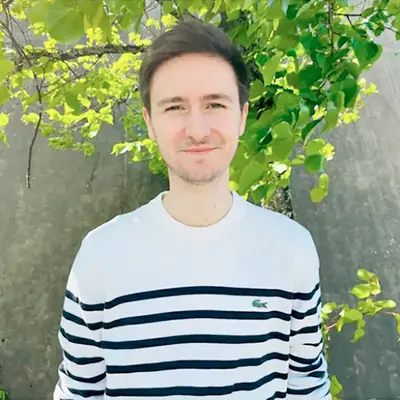
Louis Godeffroy (Ph.D. candidate at Université Paris Cité) is an alumnus of the Department of Chemistry (DER). In 2024, he was awarded the Thesis Prize of the Physical Chemistry Division (DCP) of the French Chemical Society, jointly with Joana Vaz Ramos (Ph.D. from the University of Strasbourg).
Thanks to its research-oriented curriculum, I had the opportunity to complete numerous internships in laboratories at the forefront of innovation, which helped shape my thesis project—funded by the School—and strengthened my passion for research. Within the Department of Chemistry, I also received personalized guidance that greatly contributed to the development of my projects.
“ENS Paris-Saclay provided me with a broad, interdisciplinary education that continues to help me tackle a variety of challenging projects. Thanks to its research-oriented curriculum, I had the opportunity to complete numerous internships in laboratories at the forefront of innovation, which fueled my thesis project—funded by the School—and strengthened my passion for research. Within the Department of Chemistry, I also benefited from personalized guidance that greatly contributed to the development of my projects.”
After two years of general studies in the School’s Department of Chemistry, he chose to pursue a Master’s degree (M2) at Sorbonne University to specialize in electrochemistry and X-ray spectroscopy, a specialization unique to that university. Following this M2 year, he completed a Pre-doctoral Research Year Abroad (ARPE) as part of Professor Tschulik’s team at Ruhr-Universität Bochum in Germany.
He studied the platinum/water interface using the “nano-impact” method, an electrochemical technique that allows for the direct investigation of the behavior of individual nanoparticles in dispersion. Intrigued by this emerging field of nanoelectrochemistry, he then began a doctoral thesis under the supervision of Frédéric Kanoufi at Université Paris Cité.”
Studying the reactivity of nanoparticles without interference from binders and additives present in battery and electrolyzer electrodes
“ My dissertation focused on studying the (electro)chemical reactivity of individual nanoparticles using microscopy techniques, particularly super-resolution optical microscopy. Unlike the nano-impact method, which isolates nanoparticles temporally, my approach involved isolating them spatially to enable higher-throughput analyses. The main objective was to study the reactivity of nanoparticles without interference from binders and additives present in the electrodes of batteries and electrolyzers—systems that are crucial for the energy transition. This approach allowed me to better understand the complex mechanisms of various systems, such as nickel nanoparticles used as catalysts for water reduction.”
Ph.D. Thesis Award from the Physical Chemistry Division (DCP) in 2024
In 2024, he received the Thesis Award from the Physical Chemistry Division (DCP), jointly with Joana Vaz Ramos (thesis at the University of Strasbourg).
“Receiving this award is a personal achievement that motivates me to continue my work in the field of physical chemistry. That said, I must emphasize that this thesis would not have been possible without the exceptional guidance of my thesis advisor, Frédéric Kanoufi, and my co-advisor, Jean-François Lemineur.”
The development of X-ray microscopy (STXM) under electrochemical conditions
He is currently pursuing a postdoctoral fellowship at the Helmholtz-Zentrum Berlin, where he works primarily at the BESSY II synchrotron on the development of X-ray microscopy (STXM) under electrochemical conditions.
This technique, which is more advanced than those used during my Ph.D., provides precise chemical information about the materials under study. My goal remains the same: to explore new materials for energy applications.
In the longer term, I hope to return to France to develop innovative analytical methods that will contribute to a better understanding of the fundamental mechanisms of energy systems.