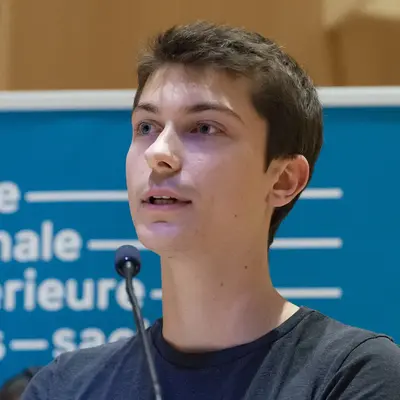
Florian Dorchies is a former student at the École Normale Supérieure in the Department of Teaching and Research (DER) in Chemistry.
“Students admitted to ENS Paris-Saclay will have access to a scientific education of the highest caliber. Beyond traditional career paths such as research and teaching, the School also offers the opportunity to pursue dual degrees with engineering schools, specialized tracks in artificial intelligence or the sciences for ecological transitions, the option to pursue entrepreneurship, and more… ”
Portrait
What is your background?
I studied in the Department of Chemistry from 2017 to 2021.
During my junior year, I completed a pre-doctoral research year abroad (ARPE) in Professor Antoni Llobet’s laboratory at the Institut Català d'Investigació Química (ICIQ) in Tarragona, Spain. During this ARPE year, my research focused on the development of a Covalent Triazine-based Framework (CTF) and a ruthenium-based molecular catalyst for photoinduced water oxidation.
I would like to thank the School for establishing the ARPE program, which offers us the opportunity to spend nine months abroad conducting research. It is a particularly enriching experience for those interested in research, but also for those who haven’t had the chance to travel abroad much until now.
I then completed my Master 2 at Sorbonne University (Analytical and Theoretical Physical Chemistry track—CAPT), specializing in electrochemistry. I completed my Master’s 2 internship at the Collège de France under the supervision of Alexis Grimaud and was awarded a specific École Normale Supérieure doctoral contract (CDSN) to continue my work there toward a Ph.D.
Did you know from the start what you wanted to do when you entered ENS Paris-Saclay?
I already knew I wanted to pursue academic research in chemistry when I entered ENS Paris-Saclay, though I didn’t know exactly which field yet. The wide range of topics covered in my L3 and M1 programs helped me figure it out fairly quickly.
What is the topic of your doctoral thesis at the Collège de France?
I owe my ability to pursue my Ph.D. to the School, as I am currently working on my dissertation at the Collège de France under the supervision of Alexis Grimaud, thanks to a Specific Doctoral Contracts for Normaliens (CDSN) fellowship.
My dissertation topic focuses on organic electrochemistry. More specifically, I’m interested in how the composition and structure of the electrolyte (solvent + supporting salt) at the nano- and micrometer scales can influence organic electrochemical reactions and thus affect their yield and selectivity.
What do you plan to do in the future?
I hope to become a researcher in academia, if possible at the CNRS.
Can you tell us what the School has provided you during these four years of your degree program?
One of the highlights of our education in the Chemistry Department is the immersive internships we complete during our first year. We spend one day a week in a School laboratory under the guidance of a researcher, with the sole purpose of discovering the world of research. I was particularly impressed by the availability and trust shown to us by the School’s researchers throughout these internships, especially Gilles Clavier from the PPSM lab, with whom I completed this internship. Looking back, it becomes clear that we have very little knowledge of chemistry upon graduating from preparatory classes—even from the PC track—and so completing these immersive internships, in addition to the “traditional” curriculum, was particularly enriching.
The depth of the curriculum taught in the L3 and M1 programs, which covers a wide range of fields in chemistry, gives us a broad perspective that allows us to choose internships and a thesis topic in the area that best suits us. The breadth of topics covered during our time at the School still allows me today to understand the basics of research fields in which I am not a specialist, which facilitates scientific discussions with other students and researchers.
Finally, the ARPE year allowed me to devote an entire year to conducting research and thus gain experience in a research laboratory before beginning my thesis. This year also reaffirmed my desire to pursue a career in academic research.
What advice would you give to students who are hesitant about coming to ENS Paris-Saclay?
Students who enroll at ENS Paris-Saclay will have access to a scientific education of the highest caliber. Beyond the traditional career paths of research and teaching, the School also offers the opportunity to pursue dual degrees with engineering schools, specialized tracks in artificial intelligence or sciences for ecological transitions, the possibility of pursuing entrepreneurship, and more… There is also a wide variety of clubs, sports, and student organizations, which are detailed on the School’s website and in the Alpha brochure, allowing students to spend four years that are enriching both academically and extracurricularly.